
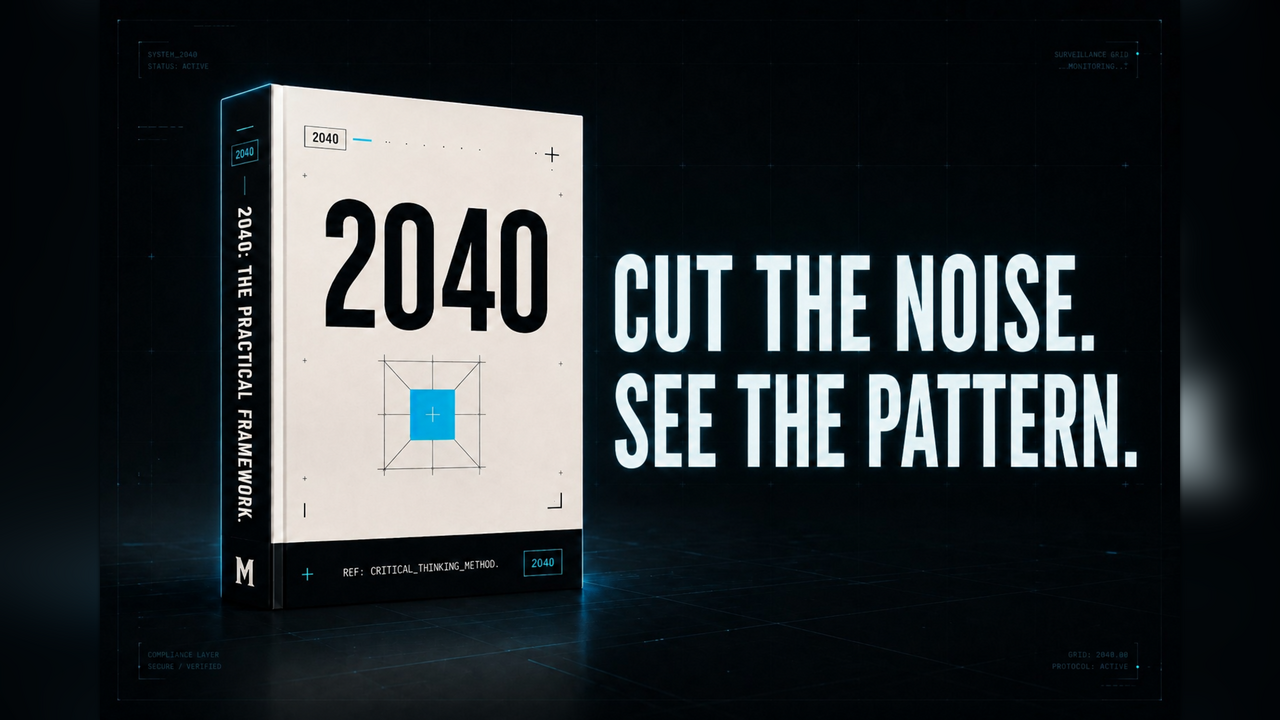
2040 — a fintech novel. And a portable method for reading your own industry.
Munich, 2040. One variable changed – money – everything else held constant. Money has become a behavioural sensor: it scores you, corrects your past, decides what you can buy.

That is the surface. Below it: a method. Look at the small, convenient concessions being introduced in your sector – fintech, law, medicine, marketing – and ask what they become in fifteen years. The novel gives you the lens.
Sixteen chapters. Eight free on Substack. This campaign funds 9–16 and the finished book. €5,000, thirty days, delivered August 2026.
Table of content:
- Read Chapter One;
- Three signals from 2026;
- What happens in the story;
- What readers have said;
- What the campaign funds;
- The publisher;
- Who this book is for;
- Why now.
What this book actually is
Most readers first meet 2040 as a fintech thriller — a cinematic dystopia showing where current trends lead. That reading is correct. It is also the surface.
Below the surface, the book teaches one specific skill: to see separate signals from the present as parts of one connected picture. Cut the noise. Build the picture. The cinematic format is not a storytelling choice. It is a method.

The novel changes exactly one variable in the world we live in — money — and holds everything else constant. Same streets, same buildings, same people, same daily routines. Only the money is different. It has become a tool that tracks behaviour. Watching what changes when a single variable moves is how models teach the reader to see. Each chapter is a case study in separating signal from noise.
Backers of this campaign are the first readers applying the method before the book that describes it is finished.
The method is not specific to fintech
The 2040 lens adapts to any industry. Architect, doctor, software engineer, lawyer, consultant, marketer — the method applies. Look at the small, convenient concessions and bureaucratic rules being introduced in your sector right now. Ask what they become in ten or fifteen years, taken to their natural end point. The novel gives you the method. The rest of the picture is yours to draw.
Three signals from 2026
The book's realism does not rely on imagination. It rests on real documented changes, each dated, each in the public record. Three examples.
Signal 1. A unified graph of client data.
In April 2026 the EU Council agreed the final text of the Payment Services Regulation. It establishes the legal ground for banks to share fraud-related behavioural data across providers. Before PSR, each bank held its data separately. After PSR, elements of your payment behaviour become part of a shared data system that the entire banking system can read.
In the novel, this layer grows into the Payment Integrity Graph — a system that connects every transaction with geolocation, sector risk profiles, and contact history. It was not invented. It grew from PSR.
Signal 2. Two classes of customers in one country.
On 28 April 2026 the UK introduced protections against sudden bank account closure — ninety days' notice, written reasons. But only for accounts opened after that date. Everyone with an older account stayed under the old regime, under which 453,230 accounts were closed in 2025, most without detailed explanation.
In the novel, the principle expands. Your rating and the date of your consent determine whether you can buy a train ticket. Your rights depend not on who you are, but on when you signed the contract.
Signal 3. Money with a built-in power to block payments.
On 8 April 2026 the US Treasury proposed requiring digital money issuers to embed into their code the ability to block, freeze, and reject transactions on a regulator's signal. That same month, Tether froze more than $344 million in USDT across two addresses in coordination with OFAC and US law enforcement.
In the novel, this architecture makes changing a transaction after it happened possible: an algorithm recalculates a past purchase because money can now follow programmed rules. Money that can be programmed to block can be programmed to do anything.
Read separately, these look like normal-looking rule changes. Read together, they look like a blueprint. The gap between 2026 and 2040 is not a technological leap. It is a series of small compromises.
What happens in the story
 Munich,
2040. Max de Vries, a former head of security at
Deutsche Bank, walks the sealed exclusion zone north of the city,
DFT-21, recovering traces of the world before PSD5. On one such run he
retrieves a hard drive left by Anna Kravchenko, a
journalist who vanished in 2027. The drive contains evidence of how
the control architecture was designed, and by whom.
Munich,
2040. Max de Vries, a former head of security at
Deutsche Bank, walks the sealed exclusion zone north of the city,
DFT-21, recovering traces of the world before PSD5. On one such run he
retrieves a hard drive left by Anna Kravchenko, a
journalist who vanished in 2027. The drive contains evidence of how
the control architecture was designed, and by whom.
Jamie Müller, a Financial Monitoring Agency analyst with a rating of 847, sees his missing father's name on Anna's drive. He writes back to Max: I'm in.
Mia van Doren, a Spiegel correspondent, watches her colleague get arrested at Davos for asking a single question the system did not allow. She reaches Sophie Clark, an operator inside the underground hidden financial network that serves the eight million Europeans the system has decided are inconvenient.
 All
four converge on a bar beneath the Asam Church, one of the last blind
spots in Munich, and begin to assemble something the architecture was
not built to survive.
All
four converge on a bar beneath the Asam Church, one of the last blind
spots in Munich, and begin to assemble something the architecture was
not built to survive.
Two architectures
The book divides into two halves.
Chapters 1–8 — the architecture of control. Published. The Payment Integrity Graph, changing transactions after they happened, the Liberty Blackout, and the three human shortcuts the system was designed to weaponise: trust in authority, following the majority, fear of loss. This is the warning layer — how a world like this is built without anyone ordering it directly.
Chapters 9–16 — the architecture of choice. After the crowdfunding. How people build communities that operate inside such a system, read its rules, and expand the space for decisions. This is the solution layer. It is the half of the book early readers keep asking about.
Subculture-type communities
Most corporate communities run on reward-based loyalty — conditional loyalty exchanged for cashback, team events, free coffee. These structures collapse at the first serious pressure. A competitor offers three per cent more; loyalty evaporates.
 The
characters in 2040 build differently. Strangers become a community
without one central point that keeps working even when one part fails.
It includes people like Sophie Clark, who know the system's
architecture from the inside and use its own logic against it. These
structures cannot be bought with bonuses. Commitment inside them is
built through shared reading of the same signals, not through rewards.
The
characters in 2040 build differently. Strangers become a community
without one central point that keeps working even when one part fails.
It includes people like Sophie Clark, who know the system's
architecture from the inside and use its own logic against it. These
structures cannot be bought with bonuses. Commitment inside them is
built through shared reading of the same signals, not through rewards.
The full edition of the book includes an appendix of applied materials on building subculture-type communities. Not a motivational guide. A practical playbook — the architectural principles the second half of the book puts into narrative form.
A community that holds under pressure starts with people who see the same thing when they look at the world. Not people who think alike. People who know how to read the same signals.
What readers have said
The reviewers below are the first professional readers of the eight published chapters. They read the book before the campaign was announced and without commercial arrangement.
"There is no need for tanks or revolutions, simply comfort, convenience and a silent majority which is not interested in asking difficult questions. The account is clear, well-written and intellectually challenging."
— David Whitehouse, PhD, ex-Bloomberg editor, «The Dark Side of Development» Substack.
"By the time you are reading Chapter 6, you realise you have been boiled alive. The frog metaphor is not a throwaway line. It is the thesis of the entire book."
— Anna Levitt, founder of bubblebossco.com, «How to Boss AI» Substack
"A surgically precise masterclass in speculative fintech horror. If you value your privacy, your autonomy, or your past, read this book before the system decides you should not."
— Farida Khalaf, organizational-systems writer, «Lights On» Substack
"The technical architecture of the story reads less like worldbuilding and more like a leaked briefing document from a system already in the works in some lab."
— Joel Salinas, AI strategy coach, «Leadership in Change» Substack
The forewords
The book opens with two forewords.
David R. Whitehouse, PhD, former Bloomberg editor and author of The Dark Side of Development, frames 2040 as journalism about the near future rather than speculation. His opening piece is adapted from his review Ever-decreasing dystopias.
Dr Oleg Maltsev closes the opening with an essay applying to 2040 the analytical framework of his book Dancing with Time. Volume I. The Origin. Maltsev reads the novel through the architecture of controlled environments: how people inside constrained systems learn to read the rules faster than the institutions that built them.
Together, the two forewords position 2040 between investigation and method: not only a story about financial infrastructure, but a way of reading how controlled environments are made — and how people learn to move inside them.
What the campaign funds
Funds raised through this campaign are allocated across four categories.
Chapters 9–16. Completion of the second half of the manuscript, currently in draft.
Editorial. Full editorial pass across all sixteen chapters, including fact-checking of every regulatory reference against primary EU sources.
Cover, typography and production. Final visual identity and layout for the book.
Distribution. Delivery to backers in DRM-free digital formats and preparation for retail release on Amazon in September 2026.
The four items above are the practical work. The claim behind them is simpler: this campaign completes a diagnostic tool that a small number of professional readers have already begun applying to their own sectors.
If the campaign clears its base target, additional stretch outcomes will be announced against defined thresholds. Details are held until the thresholds are crossed, not before.
Optional add-on — Collector's Hardback
A collector's hardback edition through Bookvault will be offered separately to tier 2 and above backers after the campaign closes, at €45 plus EU shipping, produced in a single print run once minimum orders are met. This is not a Crowdfundr reward tier; details go directly to backers at eligible tiers by email after the campaign.
The author
Mila Agius is a behavioural psychologist working in the Gigerenzer school on decision-making under uncertainty. Her published work applies fast-and-frugal heuristics to senior hiring, fintech product design, and regulatory analysis. She has worked with fintech teams and regulators on the same protocols the novel builds from.
The eight published chapters were written in the same period Mila was reviewing regulatory drafts of the type the novel extrapolates from.

She writes under a pseudonym. The face is not disclosed; the position is. The novel is an artefact of that position, made readable.
Her Substack, Heuristics vs Traps, publishes analytical essays on how decisions are shaped alongside the novel's chapters.
The publisher
The campaign is organised by Applied Knowledge Group S.R.L., a Romanian company based in Iași, directed by Daryna Karuna. AKG carries the legal, financial and practical setup of the project: contracts, tax compliance, backer relations, printing, distribution and delivery. Backers transact with AKG.
Daryna Karuna is Media Coordinator at the European Academy of Sciences in Ukraine (EUASU). She has twelve years of field research across forty countries with the Expedition Corps under Dr Oleg Maltsev. On Substack she writes The Leverage Point, on psychometrics and decision risk in senior hiring, and Expedition Files, on how institutions actually work. She is the authorised representative of the book for partnership, media, and collaboration enquiries. She is also the authorised representative of the book for partnership, media, and collaboration enquiries.
Who this book is for
Anyone whose profession includes reading regulatory signals for a living — fintech operators, compliance professionals, EU policy observers, journalists covering financial infrastructure.
And anyone in any other field — architect, doctor, engineer, lawyer, consultant, marketer — who can apply the same lens to their own sector. The same pattern appears wherever convenience, safety or efficiency become reasons for changing the rules. Fintech is simply where it is easiest to see first.
Readers who back the campaign form the first named cohort of that readership. Their names are recorded in the book from the €18 tier upward.
Why now
Every core mechanism in the book has a recognisable prototype in 2026. Three of them are documented above. There are more: the ECB digital euro pilot with a programmability layer in the specification; past transaction changes legalised in narrow contexts across the EU; declining cash acceptance well ahead of any legal requirement; account closures and risk-based exclusion without stated cause documented across the EU and UK.
The point is not to predict 2040. It is to recognise 2026 before it becomes ordinary.
The first chapter is free. It is one click away.
 Read
one chapter. Test the model against the world you already know. If it
holds, help finish the book. If it does not, close the tab. Either
way, the eight published chapters remain free.
Read
one chapter. Test the model against the world you already know. If it
holds, help finish the book. If it does not, close the tab. Either
way, the eight published chapters remain free.
Chapter one: DFT 21. The Zone
Project site: the2040model.com
Author's Substack: Mila Agius
Cut the noise. Build the picture.
Perks

The finished ebook of 2040, delivered in August 2026 in EPUB and PDF, before the retail edition goes live on Amazon and other platforms in September 2026.
Sixteen chapters. Chapters one through eight are the eight
already published on Substack in polished, edited form. Chapters nine
through sixteen are new, written and edited during this campaign and
released with the book.
Delivery: August 2026.
Places: unlimited.

Everything above, plus the Reading Companion: a 15–20 page PDF explaining 2040 as a method of forecasting. Includes a working breakdown of 10-15 documented signals from 2026 that anchor the novel's realism, chapter cross-references, and the analytical logic backers can apply to their own field. Read the fiction with the reference layer open.
The method behind the Companion is previewed in 2040: A Novel With Practical Tools for Business and Self-Diagnosis, co-authored with Daryna Karuna. The essay walks through three of the documented signals in full: the EU Payment Services Regulation (April 2026), the UK's split-tier customer protections against arbitrary account closure (April 2026), and the US Treasury's proposal on programmable stablecoin controls (April 2026).
The Companion is the fuller version: ten to fifteen signals, chapter cross-references, and the reasoning template backers can apply to their own sector.
Read the fiction with the reference layer open. Plus your name in the backers' section at the end of the book if you wish.
Delivery: August 2026 (ebook); September 2026 (retail
edition acknowledgements go live).
Places: unlimited.

Everything above, plus The 2040 Method Bundle: two working documents that operate as a single method — one for building structures that hold, one for reading spaces that do not want to be read.
The Practitioner's Section on subculture communities.
A practical playbook of the structural principles for building organisational cores that hold under pressure. Written for business owners, community managers, consultants, and team leads. Not motivation. A method, drawn from field research behind the novel's second foreword.
Developed publicly across the Subculture Communities series on Substack. Backers can read the essays before buying and know exactly what analytical layer they receive.
Why Subcultures Outlive the Fortune 500 sets the three engineering nodes — core myth, two-force engine, relationship with death — that separate centuries-long structures from those that collapse within a founder's lifetime. Case studies: the Order of Malta and the 'Ndrangheta.
Five Brands That Tried to Build a Subculture applies the framework to CrossFit, Theranos, WeWork, Zappos, and Patagonia. Only Patagonia passes.
Apple After Steve Jobs explains why the most valuable company in history is not a subculture.
The McKinsey Founder Test is the counter-example. Marvin Bower gave up his name, his liquidity, his control, and built a subculture inside a commercial firm that has outlived him by two decades.
The Practitioner's Section in the finished book takes the framework further than any of the essays. It is written for people who have read the case studies and want to know how to apply the diagnostic to their own organisation.
Dr Oleg Maltsev's Dancing with Time. Volume I. The Origin
A 180-page criminological monograph on the French banlieue, urban space, and protective navigation. First English translation.
Where 2040 reads the seams in financial architecture, Maltsev reads them in the architecture of cities. Same analytical chassis. His book gives the vocabulary; 2040 puts it to work.
The monograph teaches one skill: reading a space accurately enough to move through it without being registered. Sophie Clark moves €3,127 across fourteen jurisdictions in three-second windows because she has learned to read the graph.
The first chapter is available in English on Substack: The France They Don't Show Tourists.
Five sections: space, power, body, thinking, transmission. The closest thing in print to a technical manual for staying legible to yourself while remaining illegible to systems that presume to read you.
Why these two documents come together
One teaches how to build structures that hold. The other teaches how to move through structures built against you. A working method needs both.
Delivery: August 2026 (both digital, PDF and EPUB, DRM-free).
Places: unlimited.

Everything above, plus your name — or a name you choose — becomes a character in chapters 9 to 16.
How this works — the Privacat precedent
Chapter 8, published March 2026, introduces the Archivist inside the underground network Sophie Clark operates in. Her handle is Privacat. She is Carey Lening — real privacy adviser, DPO, author of Privacat Insights on Substack. She was written into the chapter with her consent, using material from her public work.
She appears in the side chapel of Azam bar, half-veiled by a carved column, a rolled cloth display beside her, a mongrel cat on her lap. Black hair shot through with silver. Sharp, tired legal eyes that have read too many policy drafts and euphemisms for surveillance. Her essay The Ladder to Nowhere is quoted directly in the chapter — its formulation of how convenience becomes infrastructure functions as the analytical spine of the scene.
Read Chapter 8 to see the exact level of integration this tier delivers.
What you get
Your chosen name becomes a named character in one of chapters 9 to 16. Physical description, position within the underground, narrative function. Where relevant, your own public work may be integrated into the character, on the Privacat principle.
No name, likeness, biography, public work, or identifying material will be used without a signed release form. If consent is not completed, the pledge converts to The Practitioner (Tier 3).
Limited Edition — what does not carry
This tier is Limited Edition. Three places, because each character is
written by hand. The Character Cameo is reserved for the three backers
at this tier and does not repeat in future campaigns or editions of
the book.
This tier does not include the Founding Patron
recognition from Tier 6 or the Roundtable seat from Tier 7. Both are
their own Limited Editions.
If a backer later changes their mind about consent, the slot converts to Tier 3.
Delivery: August 2026.
Places: 3.

Everything above, plus a two-hour live session with Farida Khalaf on the architecture and mechanics of building subculture-type communities — the layer the Practitioner's Section (Tier 3) points to but cannot fully deliver in writing.
Who is Farida Khalaf
An economist by degree, a data engineer by profession. She has worked across international finance, NGOs, multilateral programs, and government contracts. She now writes Lights On on Substack, on systems, incentives, and entropy inside modern organisations. Her working thesis — that most organisational failures are structural distortions of reality, not operational — sits alongside the framework introduced in the Practitioner's Section. She is one of 2040's endorsers and shares Mila's line of thinking on subcultures.
In her essay Beyond Web3: The Architecture AI Systems Actually Need Farida picks up Mila Agius's subculture framework and tests it against her own field evidence. The session in this tier turns that same framework into practical work.
What the session delivers
The Practitioner's Section provides the framework. The session covers what written material cannot: how the architecture holds under load, why some node configurations survive shocks that break others, and the second-order dependencies that only become visible in live discussion.
Three components across the two hours:
The roadmap and technological schema. An implementation map for building subculture-type communities from scratch: step-by-step architecture, decision points, diagnostic checkpoints at each stage. Farida walks the group through it live as the structural spine of the session.
Case work. Functioning models walked through with the mechanisms exposed.
Open Q&A. Open to questions from all five participants together. Detailed individual case analysis can be arranged separately with Farida outside the campaign.
This is the operational layer that follows the framework — not a duplicate of Tier 3.
Format
Two-hour Zoom session, in English, August 2026. On the intake form, participants select one of three focus tracks:
- Building from zero — a community that is still forming or does not yet exist.
- Repairing existing — a community that is not working the way it was meant to.
- Brand and marketing application — the framework applied to brand loyalty, product communities, and customer groups.
If any focus track fills first, additional sessions run under the same program. Recordings of all sessions are shared with every workshop backer — one paid place, access to all session material.
What backers get: the architecture at a depth the written material cannot reach; the Blueprint as a personal reference; the case work as traceable models; direct answers to questions; recordings of all parallel sessions; hands-on exposure to the method.
Estimated delivery: August 2026.
Places: 15

A patronage position of the kind that used to fund the first editions of books worth publishing. Three names, recorded in the opening pages of 2040 as those whose support brought the first edition to print. The position is not for sale after the campaign closes and cannot be replicated in future editions.
Only three names will become part of the first edition forever.
Everything from Tier 3 (The Method Bundle) is included, along with recognition on the dedicated Founding Patrons page in the book's front matter.
What this tier is for
This tier is for readers who want to support the release of 2040 — the book, the method, the project — and for whom acknowledgement in the opening pages is a fitting form of that support. No bonuses. No layered contents. The gesture is the point.
Optional: Community Architecture Session with Farida Khalaf
If a Founding Patron wishes to take one of the 15 seats in the Tier 5 Community Architecture Session, a seat is reserved on request through the intake form after the campaign closes. Subject to workshop availability at the time of the request. This is not automatic — it is at the Founding Patron's discretion.
Limited Edition — what does not carry
This tier is Limited Edition. Its recognition — the Founding Patrons page — is reserved for the three backers at this tier and does not transfer to Tier 7.
This tier does not include the Character Cameo from Tier 4. Character Cameo is its own Limited Edition, reserved for its three backers.
Delivery: August 2026.
Places: 3.

A private two-hour roundtable with Dr Oleg Maltsev on how subculture-type systems are actually built — from zero, step by step, at the level where the mechanics work. Six seats. Not available in any other format, and it does not repeat.
What backers get
The Practitioner's Section (Tier 3) provides the framework. Farida Khalaf's workshop (Tier 5) covers the operational layer. This tier goes further: the methodology in the hands of the person who built it.
The specific topics for the roundtable are shaped by the group. After the campaign closes, the six backers submit their focus areas through the intake form, and the session is built against the group's collective interest — two or three working themes that are actually useful to the people in the room, at the depth written material cannot reach.
This is the layer transmitted directly by the source. What the roundtable delivers is calibrated by who is at the table.
Who is Dr Oleg Maltsev
Academician of the European Academy of Sciences of Ukraine. Full member of the International Society of Criminology, the American Psychological Association, and the American Philosophical Association. Editor on the boards of American Behavioral Scientist, Baudrillard Now, and Dogma.
Founder and director of the Memory Institute. His Expeditionary Corps
has conducted more than 40 field expeditions across Europe, the United
States, Mexico, Egypt, and South Africa — with particular focus on the
'Ndrangheta, the Camorra, the Mafia, and the Russian and South African
criminal traditions. That research is the primary source material
behind the subculture framework in Tier 3.
Format
Two-hour Zoom session, in English, August 2026. Six participants. Recording provided afterwards.
Optional: Community Architecture Session with Farida Khalaf
If a Roundtable backer wishes to take one of the 15 seats in the Tier 5 session, a seat is reserved on request through the intake form.
Limited Edition — what does not carry
This tier is Limited Edition. The Roundtable seat does not repeat in future campaigns. This tier does not include the Character Cameo from Tier 4 or the Founding Patron recognition from Tier 6.
The session is educational and analytical; it does not provide legal, financial, security, or operational advice.
Delivery: August 2026.
Places: 6.
Highlights
See all activity1Activity
The finished ebook of 2040, delivered in August 2026 in EPUB and PDF, before the retail edition goes live on Amazon and other platforms in September 2026.
Sixteen chapters. Chapters one through eight are the eight
already published on Substack in polished, edited form. Chapters nine
through sixteen are new, written and edited during this campaign and
released with the book.
Delivery: August 2026.
Places: unlimited.
Everything above, plus the Reading Companion: a 15–20 page PDF explaining 2040 as a method of forecasting. Includes a working breakdown of 10-15 documented signals from 2026 that anchor the novel's realism, chapter cross-references, and the analytical logic backers can apply to their own field. Read the fiction with the reference layer open.
The method behind the Companion is previewed in 2040: A Novel With Practical Tools for Business and Self-Diagnosis, co-authored with Daryna Karuna. The essay walks through three of the documented signals in full: the EU Payment Services Regulation (April 2026), the UK's split-tier customer protections against arbitrary account closure (April 2026), and the US Treasury's proposal on programmable stablecoin controls (April 2026).
The Companion is the fuller version: ten to fifteen signals, chapter cross-references, and the reasoning template backers can apply to their own sector.
Read the fiction with the reference layer open. Plus your name in the backers' section at the end of the book if you wish.
Delivery: August 2026 (ebook); September 2026 (retail
edition acknowledgements go live).
Places: unlimited.
Everything above, plus The 2040 Method Bundle: two working documents that operate as a single method — one for building structures that hold, one for reading spaces that do not want to be read.
The Practitioner's Section on subculture communities.
A practical playbook of the structural principles for building organisational cores that hold under pressure. Written for business owners, community managers, consultants, and team leads. Not motivation. A method, drawn from field research behind the novel's second foreword.
Developed publicly across the Subculture Communities series on Substack. Backers can read the essays before buying and know exactly what analytical layer they receive.
Why Subcultures Outlive the Fortune 500 sets the three engineering nodes — core myth, two-force engine, relationship with death — that separate centuries-long structures from those that collapse within a founder's lifetime. Case studies: the Order of Malta and the 'Ndrangheta.
Five Brands That Tried to Build a Subculture applies the framework to CrossFit, Theranos, WeWork, Zappos, and Patagonia. Only Patagonia passes.
Apple After Steve Jobs explains why the most valuable company in history is not a subculture.
The McKinsey Founder Test is the counter-example. Marvin Bower gave up his name, his liquidity, his control, and built a subculture inside a commercial firm that has outlived him by two decades.
The Practitioner's Section in the finished book takes the framework further than any of the essays. It is written for people who have read the case studies and want to know how to apply the diagnostic to their own organisation.
Dr Oleg Maltsev's Dancing with Time. Volume I. The Origin
A 180-page criminological monograph on the French banlieue, urban space, and protective navigation. First English translation.
Where 2040 reads the seams in financial architecture, Maltsev reads them in the architecture of cities. Same analytical chassis. His book gives the vocabulary; 2040 puts it to work.
The monograph teaches one skill: reading a space accurately enough to move through it without being registered. Sophie Clark moves €3,127 across fourteen jurisdictions in three-second windows because she has learned to read the graph.
The first chapter is available in English on Substack: The France They Don't Show Tourists.
Five sections: space, power, body, thinking, transmission. The closest thing in print to a technical manual for staying legible to yourself while remaining illegible to systems that presume to read you.
Why these two documents come together
One teaches how to build structures that hold. The other teaches how to move through structures built against you. A working method needs both.
Delivery: August 2026 (both digital, PDF and EPUB, DRM-free).
Places: unlimited.
Everything above, plus your name — or a name you choose — becomes a character in chapters 9 to 16.
How this works — the Privacat precedent
Chapter 8, published March 2026, introduces the Archivist inside the underground network Sophie Clark operates in. Her handle is Privacat. She is Carey Lening — real privacy adviser, DPO, author of Privacat Insights on Substack. She was written into the chapter with her consent, using material from her public work.
She appears in the side chapel of Azam bar, half-veiled by a carved column, a rolled cloth display beside her, a mongrel cat on her lap. Black hair shot through with silver. Sharp, tired legal eyes that have read too many policy drafts and euphemisms for surveillance. Her essay The Ladder to Nowhere is quoted directly in the chapter — its formulation of how convenience becomes infrastructure functions as the analytical spine of the scene.
Read Chapter 8 to see the exact level of integration this tier delivers.
What you get
Your chosen name becomes a named character in one of chapters 9 to 16. Physical description, position within the underground, narrative function. Where relevant, your own public work may be integrated into the character, on the Privacat principle.
No name, likeness, biography, public work, or identifying material will be used without a signed release form. If consent is not completed, the pledge converts to The Practitioner (Tier 3).
Limited Edition — what does not carry
This tier is Limited Edition. Three places, because each character is
written by hand. The Character Cameo is reserved for the three backers
at this tier and does not repeat in future campaigns or editions of
the book.
This tier does not include the Founding Patron
recognition from Tier 6 or the Roundtable seat from Tier 7. Both are
their own Limited Editions.
If a backer later changes their mind about consent, the slot converts to Tier 3.
Delivery: August 2026.
Places: 3.
Everything above, plus a two-hour live session with Farida Khalaf on the architecture and mechanics of building subculture-type communities — the layer the Practitioner's Section (Tier 3) points to but cannot fully deliver in writing.
Who is Farida Khalaf
An economist by degree, a data engineer by profession. She has worked across international finance, NGOs, multilateral programs, and government contracts. She now writes Lights On on Substack, on systems, incentives, and entropy inside modern organisations. Her working thesis — that most organisational failures are structural distortions of reality, not operational — sits alongside the framework introduced in the Practitioner's Section. She is one of 2040's endorsers and shares Mila's line of thinking on subcultures.
In her essay Beyond Web3: The Architecture AI Systems Actually Need Farida picks up Mila Agius's subculture framework and tests it against her own field evidence. The session in this tier turns that same framework into practical work.
What the session delivers
The Practitioner's Section provides the framework. The session covers what written material cannot: how the architecture holds under load, why some node configurations survive shocks that break others, and the second-order dependencies that only become visible in live discussion.
Three components across the two hours:
The roadmap and technological schema. An implementation map for building subculture-type communities from scratch: step-by-step architecture, decision points, diagnostic checkpoints at each stage. Farida walks the group through it live as the structural spine of the session.
Case work. Functioning models walked through with the mechanisms exposed.
Open Q&A. Open to questions from all five participants together. Detailed individual case analysis can be arranged separately with Farida outside the campaign.
This is the operational layer that follows the framework — not a duplicate of Tier 3.
Format
Two-hour Zoom session, in English, August 2026. On the intake form, participants select one of three focus tracks:
- Building from zero — a community that is still forming or does not yet exist.
- Repairing existing — a community that is not working the way it was meant to.
- Brand and marketing application — the framework applied to brand loyalty, product communities, and customer groups.
If any focus track fills first, additional sessions run under the same program. Recordings of all sessions are shared with every workshop backer — one paid place, access to all session material.
What backers get: the architecture at a depth the written material cannot reach; the Blueprint as a personal reference; the case work as traceable models; direct answers to questions; recordings of all parallel sessions; hands-on exposure to the method.
Estimated delivery: August 2026.
Places: 15
A patronage position of the kind that used to fund the first editions of books worth publishing. Three names, recorded in the opening pages of 2040 as those whose support brought the first edition to print. The position is not for sale after the campaign closes and cannot be replicated in future editions.
Only three names will become part of the first edition forever.
Everything from Tier 3 (The Method Bundle) is included, along with recognition on the dedicated Founding Patrons page in the book's front matter.
What this tier is for
This tier is for readers who want to support the release of 2040 — the book, the method, the project — and for whom acknowledgement in the opening pages is a fitting form of that support. No bonuses. No layered contents. The gesture is the point.
Optional: Community Architecture Session with Farida Khalaf
If a Founding Patron wishes to take one of the 15 seats in the Tier 5 Community Architecture Session, a seat is reserved on request through the intake form after the campaign closes. Subject to workshop availability at the time of the request. This is not automatic — it is at the Founding Patron's discretion.
Limited Edition — what does not carry
This tier is Limited Edition. Its recognition — the Founding Patrons page — is reserved for the three backers at this tier and does not transfer to Tier 7.
This tier does not include the Character Cameo from Tier 4. Character Cameo is its own Limited Edition, reserved for its three backers.
Delivery: August 2026.
Places: 3.
A private two-hour roundtable with Dr Oleg Maltsev on how subculture-type systems are actually built — from zero, step by step, at the level where the mechanics work. Six seats. Not available in any other format, and it does not repeat.
What backers get
The Practitioner's Section (Tier 3) provides the framework. Farida Khalaf's workshop (Tier 5) covers the operational layer. This tier goes further: the methodology in the hands of the person who built it.
The specific topics for the roundtable are shaped by the group. After the campaign closes, the six backers submit their focus areas through the intake form, and the session is built against the group's collective interest — two or three working themes that are actually useful to the people in the room, at the depth written material cannot reach.
This is the layer transmitted directly by the source. What the roundtable delivers is calibrated by who is at the table.
Who is Dr Oleg Maltsev
Academician of the European Academy of Sciences of Ukraine. Full member of the International Society of Criminology, the American Psychological Association, and the American Philosophical Association. Editor on the boards of American Behavioral Scientist, Baudrillard Now, and Dogma.
Founder and director of the Memory Institute. His Expeditionary Corps
has conducted more than 40 field expeditions across Europe, the United
States, Mexico, Egypt, and South Africa — with particular focus on the
'Ndrangheta, the Camorra, the Mafia, and the Russian and South African
criminal traditions. That research is the primary source material
behind the subculture framework in Tier 3.
Format
Two-hour Zoom session, in English, August 2026. Six participants. Recording provided afterwards.
Optional: Community Architecture Session with Farida Khalaf
If a Roundtable backer wishes to take one of the 15 seats in the Tier 5 session, a seat is reserved on request through the intake form.
Limited Edition — what does not carry
This tier is Limited Edition. The Roundtable seat does not repeat in future campaigns. This tier does not include the Character Cameo from Tier 4 or the Founding Patron recognition from Tier 6.
The session is educational and analytical; it does not provide legal, financial, security, or operational advice.
Delivery: August 2026.
Places: 6.
